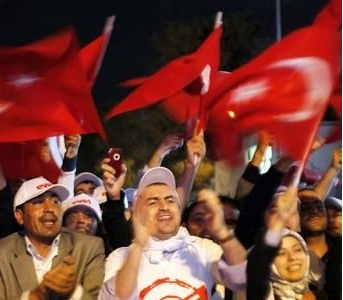
Turks have approved constitutional changes that are set to reshape the judiciary and curb the powers of the military, in a referendum seen as a tussle between an Islamist-influenced government and its secular opponents.
A provisional count, after polls closed at 14:00 GMT on Sunday, showed 58 per cent of voters approving the amendments, with 99 per cent of ballot boxes counted, according to NTV, a Turkish broadcaster.
“According to provisional results, the changes were approved by about 58 per cent … The turnout was between 77 and 78 per cent,” Recep Tayyip Erdogan, the Turkish prime minister, said.
Earlier opinion polls had suggested up to 56 per cent of Turks could approve the 26 constitutional amendments or that it might be too close to call.
“We have passed a historic threshold on the way to advanced democracy and the supremacy of law,” Erdogan told cheering supporters of a vote that was seen as a crucial test for his governing Justice and Development Party (AKP).
‘Good for the government’
Al Jazeera’s Anita McNaught reporting from Ankara, the capital, said the results are “probably better than what the government had hoped for … a slim win for the government would have been destabilising”.
Semih Idiz, a columnist for Milliyet newspaper, agreed that preliminary results were “a good margin for the government”.
“It’s better than expected, and it’s a good endorsement ahead of next year’s elections … I think the prime minister must be feeling pretty comfortable,” Idiz told the Reuters news agency.
Defeat could have damaged the AKP’s morale before a parliamentary election due by July 2011.
Erdogan has said changes are needed to strengthen democracy and bring Turkey closer to European norms, as the country continues its bid to join the European Union.
Critics of the overhaul from the “no” camp, said some of the changes would allow Erdogan’s party to take over the courts, undermining the secular nature of the Turkish state.
Some 50 million people were eligible to vote in the referendum that fell on the 30th anniversary of the 1980 military coup, which produced the current constitution, which critics say gives too much power to the military and court officials.
Kurdish activists in Turkey’s southeast, who have waged an armed campaign against the government, had called for a boycott of the vote.
EU position
The EU’s executive European Commission has backed Ankara’s attempt to reorganise the judiciary, but accused the government on Tuesday of stifling public debate over the proposals.
The AKP evolved from a series of Islamist parties banned by the courts, but denies having any aims to roll back the republic’s traditional secularism.
Polarisation over the referendum reflects Turkey’s fractured political landscape, in which a rising middle class of observant Muslims who form the backbone of the AKP have challenged a secular elite which has traditionally held power since Mustafa Kemal Ataturk founded modern Turkey in 1923.
“The battle is really not between Islamists and secularists; the battle is between reformists and those who defend the status quo,” Ibrahim Kalin, a senior adviser to Erdogan, told Al Jazeera.
Our correspondent in Ankara said that opposition parties did not mount an effective campaign against the changes.
“The leader of the Republican People’s Party (CHP) [the main opposition] could not vote because his paper work was not in order, which was symbolic of the problems in the ‘no’ campaign,” McNaught said.
To celebrate his party’s victory, the Turkish prime minister will watch his country play the United States in the 2010 Basketball World Championship final in Istanbul, our correspondent said.
A provisional count, after polls closed at 14:00 GMT on Sunday, showed 58 per cent of voters approving the amendments, with 99 per cent of ballot boxes counted, according to NTV, a Turkish broadcaster.
“According to provisional results, the changes were approved by about 58 per cent … The turnout was between 77 and 78 per cent,” Recep Tayyip Erdogan, the Turkish prime minister, said.
Earlier opinion polls had suggested up to 56 per cent of Turks could approve the 26 constitutional amendments or that it might be too close to call.
“We have passed a historic threshold on the way to advanced democracy and the supremacy of law,” Erdogan told cheering supporters of a vote that was seen as a crucial test for his governing Justice and Development Party (AKP).
‘Good for the government’
Al Jazeera’s Anita McNaught reporting from Ankara, the capital, said the results are “probably better than what the government had hoped for … a slim win for the government would have been destabilising”.
Semih Idiz, a columnist for Milliyet newspaper, agreed that preliminary results were “a good margin for the government”.
“It’s better than expected, and it’s a good endorsement ahead of next year’s elections … I think the prime minister must be feeling pretty comfortable,” Idiz told the Reuters news agency.
Defeat could have damaged the AKP’s morale before a parliamentary election due by July 2011.
Erdogan has said changes are needed to strengthen democracy and bring Turkey closer to European norms, as the country continues its bid to join the European Union.
Critics of the overhaul from the “no” camp, said some of the changes would allow Erdogan’s party to take over the courts, undermining the secular nature of the Turkish state.
Some 50 million people were eligible to vote in the referendum that fell on the 30th anniversary of the 1980 military coup, which produced the current constitution, which critics say gives too much power to the military and court officials.
Kurdish activists in Turkey’s southeast, who have waged an armed campaign against the government, had called for a boycott of the vote.
EU position
The EU’s executive European Commission has backed Ankara’s attempt to reorganise the judiciary, but accused the government on Tuesday of stifling public debate over the proposals.
The AKP evolved from a series of Islamist parties banned by the courts, but denies having any aims to roll back the republic’s traditional secularism.
Polarisation over the referendum reflects Turkey’s fractured political landscape, in which a rising middle class of observant Muslims who form the backbone of the AKP have challenged a secular elite which has traditionally held power since Mustafa Kemal Ataturk founded modern Turkey in 1923.
“The battle is really not between Islamists and secularists; the battle is between reformists and those who defend the status quo,” Ibrahim Kalin, a senior adviser to Erdogan, told Al Jazeera.
Our correspondent in Ankara said that opposition parties did not mount an effective campaign against the changes.
“The leader of the Republican People’s Party (CHP) [the main opposition] could not vote because his paper work was not in order, which was symbolic of the problems in the ‘no’ campaign,” McNaught said.
To celebrate his party’s victory, the Turkish prime minister will watch his country play the United States in the 2010 Basketball World Championship final in Istanbul, our correspondent said.
| Daily Update |  |